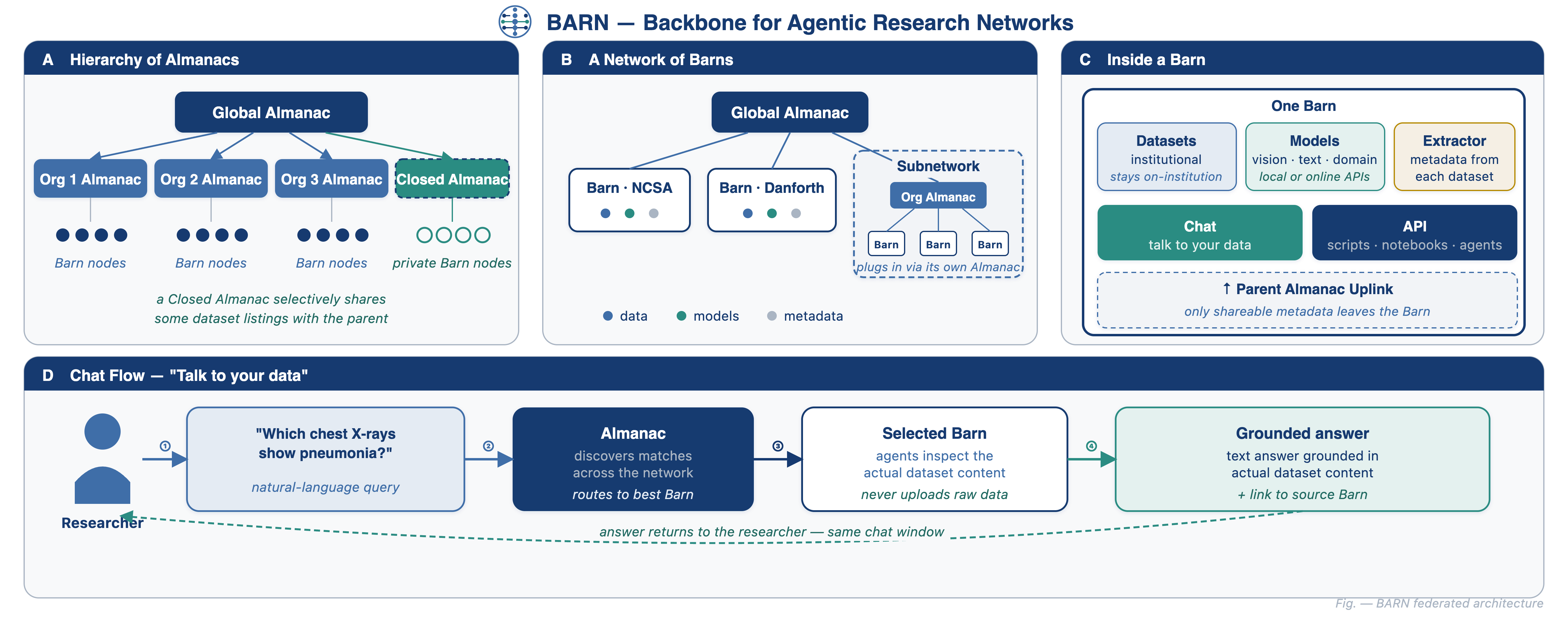
BARN — the Backbone for Agentic Research Networks — is an open-source stack that lets any research group publish its datasets as a node in a federated network. Metadata travels to a shared catalog called the Almanac; the data itself never has to leave your infrastructure.
The problem
Research data is exploding, but it sits in thousands of disconnected repositories that are hard to discover, inspect, filter, or credit. A meta-study of corn and soybean publications from 2017–2022 found that fewer than 15% of full datasets are actually shared. Correlating two sources from unrelated organizations is so obstacle-ridden that most experiments a researcher imagines simply never happen.
The compute, the models, and the tooling are all ready. What is missing is the unglamorous middle: discovery, access negotiation, filtering, provenance, and attribution. That is the gap BARN closes — without asking anyone to hand over their data.
BARN builds no central data store. Each site runs its own node; only lightweight metadata flows upward. The central footprint stays small on purpose.
Publish openly, or publish metadata only and approve access case by case. Private datasets never leave the host node — models come to the data instead.
A node fits on an off-the-shelf single-GPU workstation, and scales up to run alongside HPC systems like Delta and DeltaAI where the data already lives.
Ask in plain language instead of guessing keywords. Open-weight LLMs hosted on BARN infrastructure narrow candidate datasets over the course of a conversation.
Every access and training run is recorded, so a model carries the full list of datasets behind it — an AI bill of materials — and owners get verifiable credit.
Released under a permissive license with an explicit patent grant, so academic and commercial users can build on and deploy it without legal encumbrance.
How it works
Publishing to BARN is meant to take an afternoon, not a grant. Install the stack, point it at your datasets, and let it do the metadata work you would otherwise postpone until the end of the project.
Install the BARN stack on your own server and register it with an Almanac through a one-time handshake. No custom integration code.
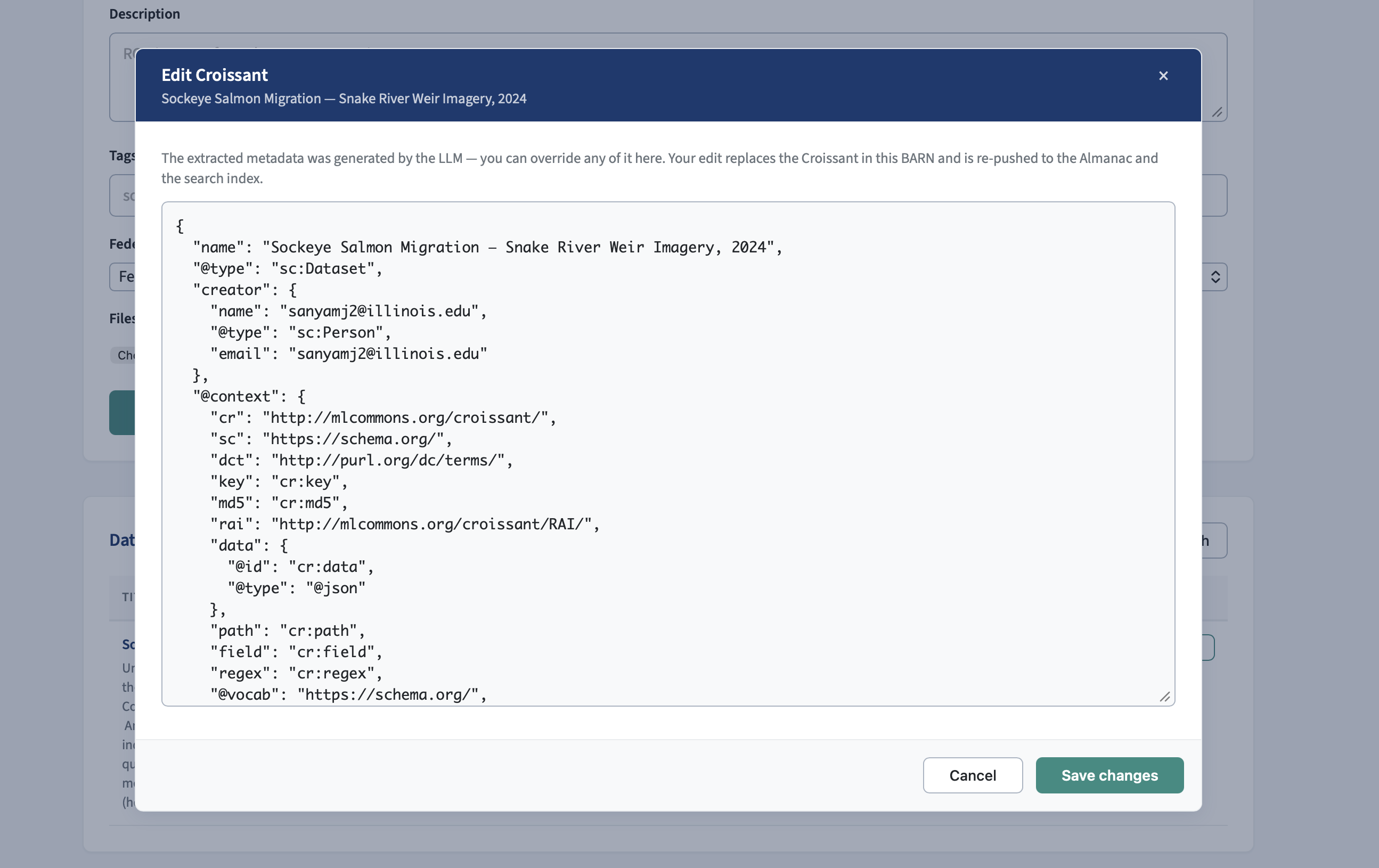
BARN reads each dataset and generates standardized Croissant metadata automatically — reviewable and editable, so you stay the authority on your own data.
Choose open access or privacy-first: publish only the description while the dataset stays private, and grant access per request. CILogon handles identity.
Your listing becomes discoverable network-wide through natural-language search, with a DOI, funding attribution, and an audit trail of every use.
The Almanac
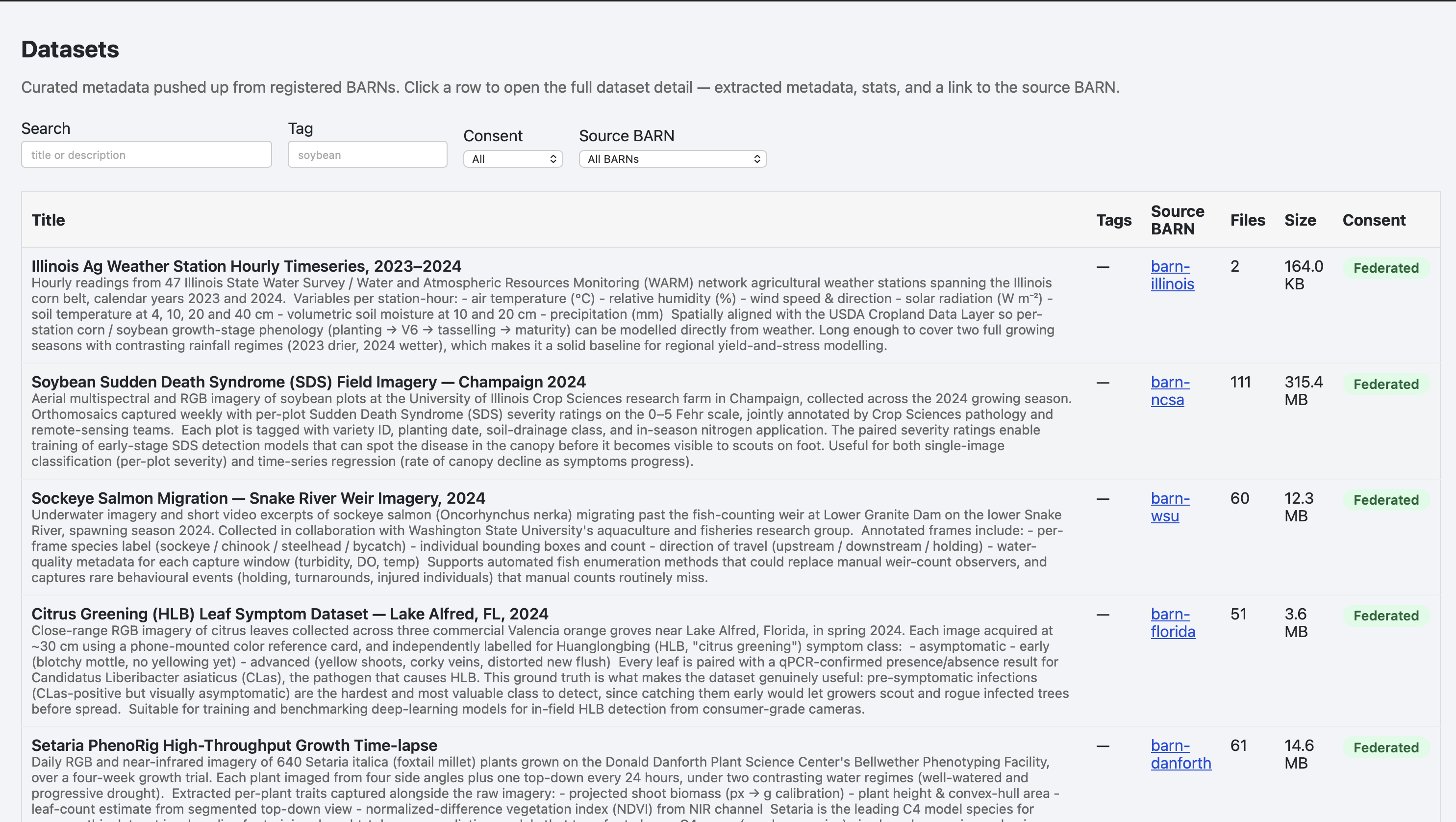
The Almanac is BARN's discovery layer: a catalog of the extracted Croissant metadata from every dataset in the network. It holds enough to identify candidate datasets and their owners; the detailed metadata back at the owning node then narrows the candidates on finer criteria.
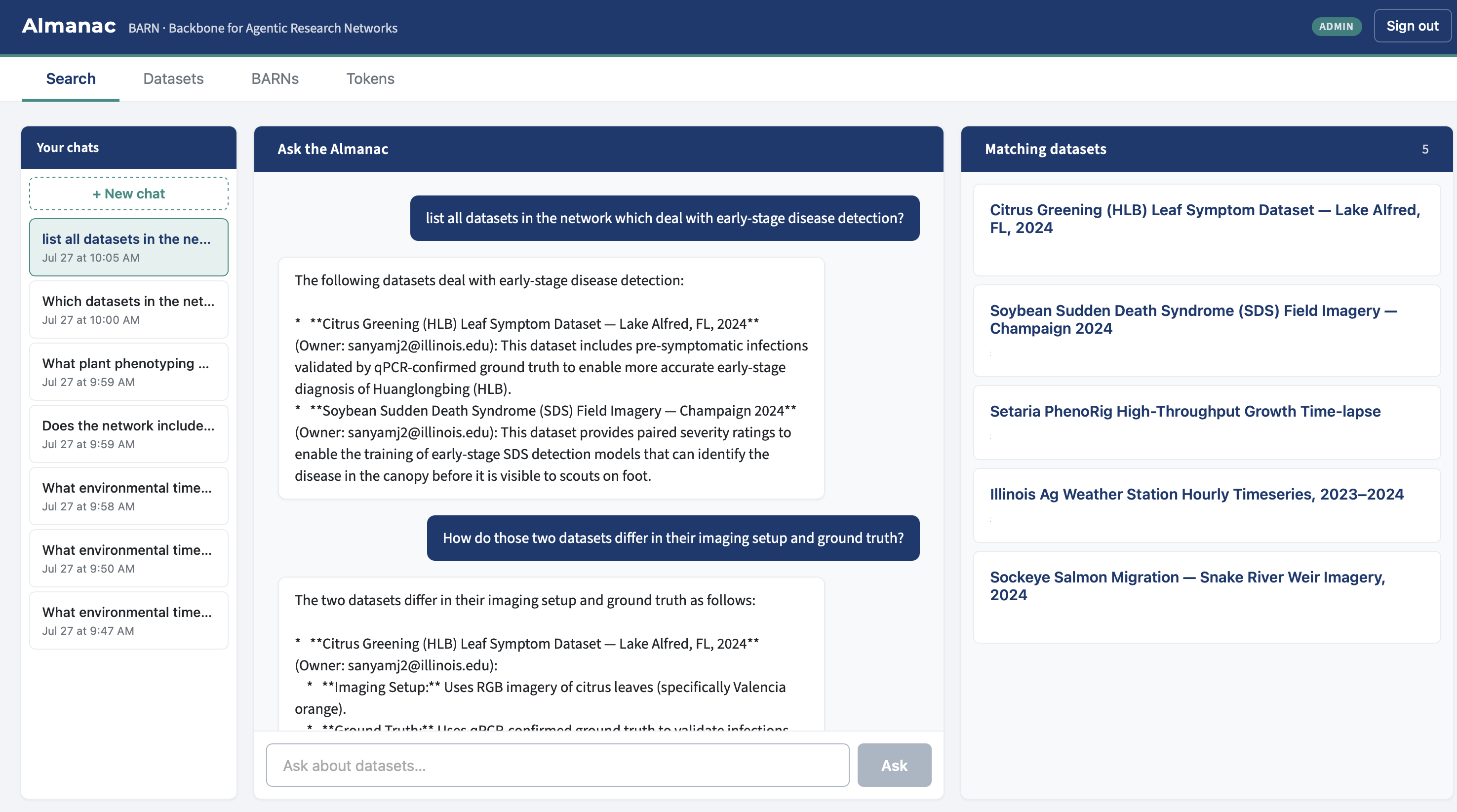
Search works two ways at once — semantic retrieval for exploratory questions, a deterministic text index for precise lookups — behind a single chat interface. Ask "give me datasets about rice," then follow up with "what growth stage?" and keep refining.
Almanacs nest. A university or company can run its own private Almanac so everyone internally can find institutional data, then selectively export chosen listings to the global Almanac. Nothing is exposed that the owner did not choose to expose.
Because BARN emits standard Croissant, discovered datasets stay directly consumable by ordinary ML tooling — discovery leads straight into training rather than dead-ending at a catalog entry.
Where we are
BARN is in an early pilot. BARN v1.0 is running at four project sites — the University of Illinois Urbana-Champaign, Washington State University, the University of Florida, and the Donald Danforth Plant Science Center — connected as a network of nodes around a shared central Almanac, in active use across agriculture, biomanufacturing, and ecology.
The pilot supports natural-language discovery, simplified upload, automatic metadata extraction, access control, and visualization, with computation on data at the local node. Transparent transfer and caching for remote sources is in active development. We expect to go public soon — the software will be released as fully open source under a permissive license with an explicit patent grant.
Researchers building models for existing data and finding data for existing models; data providers who want their holdings used and credited; industry teams assembling agentic workflows; and educators building AI and data literacy on real datasets. If you hold data that is hard for others to find, or you are hunting for data that should exist somewhere, you are who we are building this for.
Built at NCSA and the AIFARMS AI Institute, out of real frustrations with fragmented agricultural research data.
A live federated network with a central Almanac, natural-language discovery, and local computation. Invite-based, with pilot partners shaping the interface.
Permissive license with an explicit patent grant, distributable node package, reference hardware designs, and documentation so any site can join on its own.
Transparent remote data access, distributed training via model merging, a Partners Council for community governance, and open calls for new host sites in new domains.
Collaborators
BARN is piloted as a live federated network across four institutions in three research domains. Each site runs its own node and decides what it shares.
Get involved
We are actively looking for pilot partners in new domains — groups with data worth finding, and groups who need data that no one has been able to point them at. Reach out and we will talk through what standing up a node would take at your site.


